
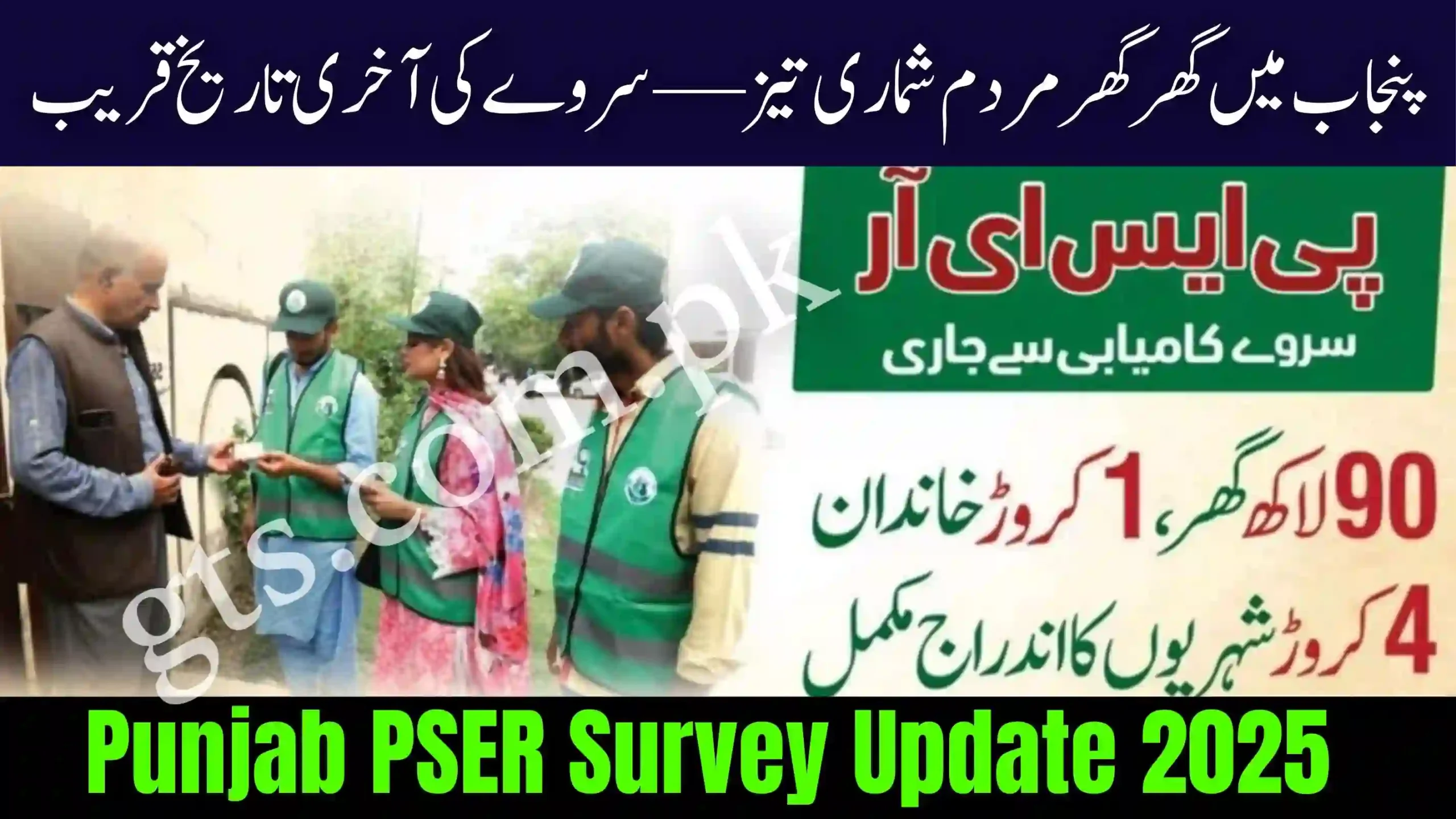
Punjab PSER Survey Update 2025: 1 Crore Families Counted — Major Impact on Social Data
The Government of Punjab has released a major update on the ongoing Punjab Socio-Economic Registry PSER Survey 2025, confirming that more than 1 crore families have already been counted under the latest data-collection drive. This makes the PSER project one of the largest socio-economic documentation efforts in the history of the province, with over 4 crore citizens now part of the updated registry.
The announcement has gained strong attention from financial analysts, economic observers, and policy experts across Pakistan, as the updated data will be used extensively in future budget allocations, subsidy reforms, economic planning, and social-welfare targeting.
For readers of GTS.com.pk, this update is highly relevant because the structure of subsidies, energy relief, financial grants, welfare targeting, and poverty-support initiatives will depend heavily on PSER verification in 2025 and beyond.
Understanding the PSER Survey: What It Means for Punjab
The Punjab Socio-Economic Registry is an official government initiative designed to create a reliable, digital database of all families residing in the province. The process involves:
- Door-to-door household data collection
- Verification of family members
- Income and employment recording
- Utilities and asset mapping
- Demographic categorization
- Digital profiling of vulnerable families
This data is intended to support the government in identifying households that genuinely require financial assistance and social protection.
The updated registry will be used for:
- Subsidized utility programs
- Income-support schemes
- Cash-assistance initiatives
- Food-security interventions
- Health and education assistance
- Agriculture and livestock support
- Youth employment programs
- Housing and loan schemes
Check Also: Pakistan Open Market Currency Rates Today Nov 20, 2025 (Latest Update)

Survey Progress: Major Highlights from the Punjab Government
According to the official update:
- 1 crore+ families registered
- 4 crore+ individuals counted
- 90 lakh+ households visited
- Door-to-door verification almost complete
- Survey teams operating daily across districts
- Final deadline set at December 31, 2025
This progress places the PSER survey among the fastest-executed government data-collection exercises in the region.

Why This Update Is Important for the Financial Sector
The PSER registry will be used to:
✔ Determine Eligibility for Subsidies
Energy subsidies, utility discounts, household relief packages, and seasonal grants will all depend on PSER-verified income levels.
✔ Target Government Welfare More Accurately
Instead of blanket subsidies, the government will shift to targeted subsidies — based on verified household economic conditions.
✔ Structure Future Budgets
Punjab’s upcoming fiscal budgets will rely on PSER data to allocate funds for poverty reduction, housing initiatives, and economic development.
✔ Support Poverty-Score Revisions
Benazir Income Support Program (BISP) and other welfare programs may align their PMT scoring with PSER findings.
✔ Enable Financial Transparency
With verified digital records, the government aims to reduce duplication, fraud, and misuse in public programs.
For analysts tracking Pakistan’s economic direction, PSER data is a key indicator of how financial resources will be distributed in 2026 and beyond.

Door-to-Door Verification: How the Process Works
PSER teams wearing official green jackets and carrying government-issued tablets are collecting the following data:
- CNIC details of all adult members
- Family structure
- Household income bracket
- Employment information
- Disabilities and special care needs
- Women-led households
- School-going children
- House type and rental status
- Utilities and consumption
Every visit is free of cost, and no surveyor is allowed to ask for money, gifts, or any type of payment.
Citizens have been strictly advised to only interact with verified PSER teams carrying official identification.

When Will the PSER Survey End?
The Punjab government has clearly announced:
⏳ Last Date: December 31, 2025
Any household not registered before the deadline may face:
- Limited access to subsidies
- Exclusion from targeted welfare
- Difficulty in qualifying for support programs
- Delays in youth-employment schemes
- Ineligibility for relief or food security packages
Therefore, families must ensure their data is recorded before the closing date.
How the PSER Survey Affects Financial Relief Programs
For GTS readers following prices, subsidies, and economic decisions — here is how PSER affects key financial categories:
🔹 Electricity Subsidies
Future unit slabs, agricultural tubes, lifeline consumers, and load-based relief packages may be tied to PSER-verified income brackets.
🔹 Utility Bill Discounts
Water, gas, and sanitation bills may offer reduced rates for PSER-recognized low-income families.
🔹 Cash Support & Income Assistance
Upcoming relief packages (especially for winter, Ramadan, and emergency situations) will rely on PSER categorization.
🔹 Agriculture & Livestock Support
Farmers and livestock owners will be identified for subsidy programs through the registry.
🔹 Housing & Loan Schemes
Home-loan qualification will be streamlined using PSER data.
Why the Punjab Government Is Pushing for Full Participation
A complete and accurate survey allows the government to:
- Identify vulnerable households
- Reduce wastage of public funds
- Stop duplicate claims
- Prevent misuse of welfare resources
- Build transparent digital welfare records
- Implement district-wise financial plans
- Improve budgeting and resource allocation
Government officials have emphasized that accurate data will ensure:
“Assistance reaches those who need it most.”
Economic Impact of Counting 1 Crore Families
Reaching the 1 crore family milestone is more than a statistical achievement — it is a major economic event.
✔ Reliable Social Indicators
The registry helps identify poverty clusters and economic pressure points across Punjab.
✔ Improved Fiscal Management
The government can allocate budget funds based on accurate, ground-level data.
✔ Enhanced Data for International Partnerships
PSER strengthens Punjab’s reporting for international organizations, development partners, and donors.
✔ Boost for Digital Governance
The initiative aligns with Pakistan’s digital transformation goals.
Benefits for Families Who Participate in PSER
Registered households will benefit from:
- Subsidized ration and food support
- Utility bill reductions
- Targeted relief packages
- Youth employment schemes
- Women empowerment programs
- Health and education support
- Housing loans and construction grants
- Social-protection benefits
These benefits will be processed faster because the government will have updated and verified data.
Check Also: Sugarcane Expansion in Cotton Zones 2025 – How Punjab’s Crop Shift Is Reshaping Agriculture
What Families Should Keep Ready for PSER Teams
To make the process smooth, households should prepare:
- CNICs of all adult family members
- Details of dependents
- Income information
- Occupation/employment details
- Phone number for verification
- Basic household data
This ensures a quick and accurate survey.
Challenges Faced During the Survey
While progress has been impressive, PSER teams have reported challenges:
- Difficulty reaching remote areas
- Misinformation shared on social media
- Families not available during visits
- Language barriers in some regions
- Incorrect or incomplete information from respondents
The government has responded by increasing staff, extending hours, and issuing public awareness messages.
Final Phase: What to Expect Next
As the survey nears completion:
- Final district summaries will be compiled
- Data will be analysed for poverty mapping
- Subsidy categorization will begin
- Employment-related strategies will be created
- Policy recommendations will be drafted
- New 2026 support programs will be announced based on PSER findings
GTS will continue tracking how PSER data influences Punjab’s financial and economic direction.
Conclusion – Punjab PSER Survey Update 2025
The Punjab PSER Survey Update 2025 marks a transformative shift in the province’s socio-economic planning. With over 1 crore families counted and 4 crore citizens confirmed, the government is approaching the final phase of one of the largest household documentation drives ever conducted in Pakistan.
For families, job seekers, and financial observers, this survey is not just a data exercise — it is the foundation of future subsidies, benefits, job schemes, and welfare opportunities.
Citizens are strongly advised to cooperate with survey teams and ensure their information is recorded before the December 31, 2025 deadline.
GTS.com.pk will continue delivering the most accurate and timely economic updates connected to PSER and other financial developments.