
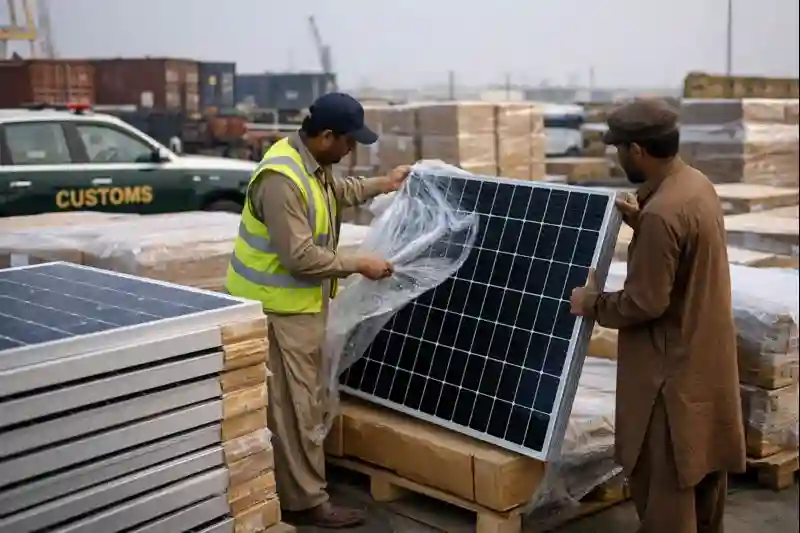
PM Shehbaz Directs Authorities to Hand Over Seized Solar Panels to Public
Prime Minister Shehbaz Sharif has officially directed the concerned authorities to hand over seized solar panels to the public in designated cities across Pakistan. These panels were earlier confiscated by Customs in Karachi. Instead of letting them remain unused in warehouses, the government has now decided to utilize them for public benefit.
According to Business Recorder, Prime Minister Shehbaz Sharif issued these instructions during a high-level meeting focused on Pakistan’s energy situation, particularly the reliability of Gwadar’s power supply and ongoing solar projects in Gilgit-Baltistan.
The Prime Minister has instructed the Federal Board of Revenue (FBR), the Power Division, and the government of Gilgit-Baltistan to devise a transparent and practical mechanism for distributing the solar panels. A formal distribution ceremony will also be organized, where the Prime Minister is expected to participate.
This move has generated strong public interest as it directly benefits citizens while supporting renewable energy adoption in Pakistan.
Government Converts Seized Goods into Public Benefit
In Pakistan, many confiscated goods remain stored for years due to legal and administrative complications. However, this time the government has decided to take a different and positive step. Instead of wasting valuable solar equipment, the panels will now:
- Support public welfare
- Promote renewable energy
- Reduce electricity burden on citizens
- Help households, institutions, and communities
This decision reflects the government’s intention to use available resources wisely, especially at a time when Pakistan is facing high electricity bills, energy shortages, and increasing demand for reliable power sources.

Focus on Gwadar: Power Supply Declared a Critical Priority
The meeting also discussed the serious electricity challenges in Gwadar, a city that holds massive economic and strategic importance for Pakistan due to CPEC and port-related activities.
Gwadar has long suffered from:
- Unstable electricity supply
- Dependency on imported power
- Frequent outages affecting daily life and businesses
To address this, Prime Minister Shehbaz Sharif declared the 40 MW power plant in Gwadar as a strategic project. He instructed the authorities to submit necessary approvals to the federal cabinet within two weeks so the project can move forward quickly.
Declaring it “strategic” ensures:
- Faster decision-making
- Priority-level implementation
- Dedicated government support
- Removal of bureaucratic hurdles
This move is expected to bring great relief to the people and industries of Gwadar.

Solarization of Pumping Stations and Desalination Plants to Be Accelerated
Along with electricity issues, Gwadar also faces water scarcity, which becomes worse when power supply is unstable. Many pumping stations and desalination plants struggle to operate due to frequent outages.
To solve this, Prime Minister Shehbaz Sharif ordered the speeding up of solarization projects, particularly for:
- Water pumping stations
- Desalination plants
- Essential public service facilities
He instructed the Power Division to:
- Review project timelines
- Identify delays
- Provide technical support
- Assist the Balochistan government with design, bidding, and execution
Shifting these critical facilities to solar energy will ensure:
- Continuous water supply
- Lower operational costs
- Reduced dependency on traditional power
- Improved quality of life for residents
This step highlights the government’s commitment to solving both electricity and water problems in the region.

Major Push for Solar Projects in Gilgit-Baltistan
Another key focus of the meeting was renewable energy development in Gilgit-Baltistan (GB). The Prime Minister reviewed progress on the 100 MW solar power project planned in the region.
Gilgit-Baltistan faces unique challenges due to its mountainous terrain, remote areas, and limited power infrastructure. Solar power is seen as a practical and sustainable solution for improving electricity availability there.
Prime Minister Shehbaz Sharif issued the following instructions:
- Results of the rooftop solar project bidding process must be presented to him before any contracts are awarded.
- Third-party validation must be conducted to ensure transparency and technical accuracy.
- Timelines for all GB solar projects must be reviewed and expedited.
These measures are aimed at guaranteeing credibility, fairness, and efficient execution.

Splitting Large Projects to Encourage Competition
One of the major challenges in Pakistan’s infrastructure development has been slow progress and lack of competition in large projects. To avoid such problems, the Prime Minister instructed the Power Division to consider splitting the 82 MW utility-scale solar component into smaller packages.
This will:
- Allow more companies to participate
- Increase competition
- Prevent monopoly control
- Reduce risks
- Speed up implementation
At the same time, the Chief Secretary of Gilgit-Baltistan has been tasked with ensuring land availability and completion of required infrastructure so the projects face no unnecessary delays.
Public Awareness and Transparency Emphasized
Transparency and communication were also highlighted as key priorities. The Prime Minister directed Federal Power Minister Sardar Awais Ahmad Khan Leghari to brief Information Minister Ataullah Tarar on the 100 MW solar project in Gilgit-Baltistan.
This briefing will help launch a public awareness campaign so citizens understand:
- Project objectives
- Benefits for the region
- Expected timelines
- Development progress
Keeping the public informed helps build trust and ensures accountability.
Why Distributing Seized Solar Panels Matters for Pakistan
Pakistan is currently dealing with:
- Expensive electricity
- Growing demand
- Limited resources
- Economic challenges
Solar energy offers a powerful solution. Distributing seized solar panels will:
- Provide immediate relief to households
- Support public institutions
- Reduce pressure on the national grid
- Encourage renewable energy adoption
- Promote environmental sustainability
Instead of remaining unused, this equipment will now positively impact people’s lives.
Pakistan’s Growing Shift Toward Renewable Energy
Pakistan has significantly increased focus on renewable energy development in recent years. Multiple projects in solar, hydropower, and wind energy are being planned and implemented.
Key benefits of solar energy adoption include:
- Lower electricity costs
- Reduced fuel imports
- Cleaner environment
- Sustainable development
- Better accessibility in remote areas
Projects in Gwadar and Gilgit-Baltistan show that the government is prioritizing regions where stable energy is most needed.
Challenges and The Road Ahead
While the directives are strong and promising, effective implementation will determine the success of these initiatives. Historically, development projects in Pakistan have often faced issues such as delays, funding complications, and administrative hurdles.
However, the Prime Minister’s focus on:
- Fast timelines
- Third-party validation
- Project splitting
- Direct monitoring
indicates a serious attempt to overcome traditional challenges.
Citizens now hope that these decisions will translate into real improvements on the ground.
Conclusion – PM Shehbaz Directs Authorities to Hand Over Seized Solar Panels to Public
Prime Minister Shehbaz Sharif’s directive to hand over seized solar panels to the public marks a major step toward supporting clean energy and public welfare in Pakistan. Along with this, accelerating solar projects in Gwadar and Gilgit-Baltistan shows a strong commitment to solving long-standing power issues in key regions.
If successfully implemented, these initiatives will improve electricity supply, reduce public burden, strengthen renewable energy adoption, and support Pakistan’s journey toward a more secure and sustainable energy future.