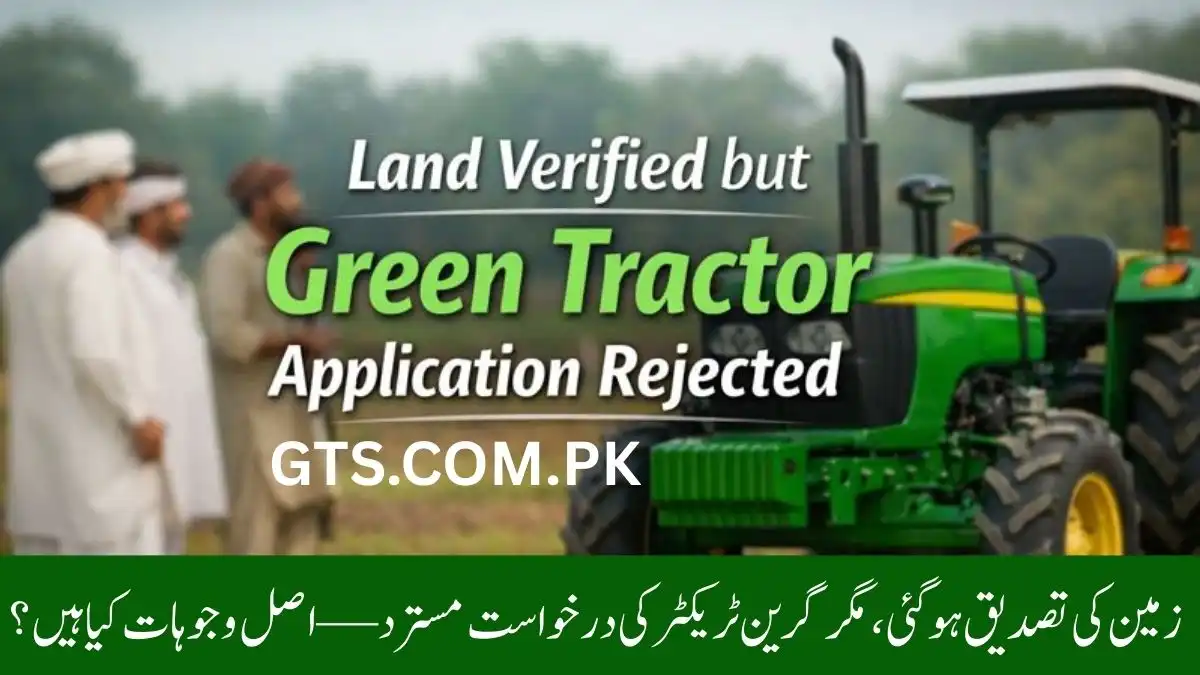
Land Verified but Green Tractor Application Rejected – Why This Happens
Many farmers in Punjab are confused and disappointed after seeing their land verified successfully but still receiving a rejection message for the Green Tractor Scheme. For most applicants, land verification is considered the biggest hurdle. So when it is approved and the application still fails, frustration is natural.
This issue has become common in recent phases of the Green Tractor Scheme. Farmers believe that once land verification is done, approval is guaranteed. However, the reality is very different.
This article explains why land verification alone is not enough, the hidden reasons behind rejection, and what farmers should understand before applying again.
Understanding the Green Tractor Scheme System
The Green Tractor Scheme is managed under the agriculture and mechanization policies of the Government of Punjab. The process is divided into multiple stages, and land verification is only one of them.
Main stages usually include:
- CNIC verification
- Land record verification
- Eligibility screening
- Duplicate check
- Quota adjustment
- Final approval or rejection
Passing one stage does not guarantee success in the next.
What Does “Land Verified” Actually Mean?
Land verification simply means:
- Your land exists in official records
- The land is registered under your CNIC
- The land size falls within allowed limits
It does not mean:
- You are selected
- You qualify financially
- You passed all scheme conditions
This misunderstanding is the biggest reason farmers feel cheated.
Top Reasons Why Applications Are Rejected After Land Verification
1. Limited Quota Problem
Green Tractor schemes always have limited tractors compared to the number of applicants. Even if:
- Your land is verified
- Your documents are correct
You can still be rejected because:
- Quota for your district is full
- Priority list has already been completed
This is the most common reason and has nothing to do with fraud or mistakes.
2. Balloting or Merit Cut-Off
In many cases, applications go through:
- Computerized balloting
- Merit-based shortlisting
If applications exceed quota, random or merit-based selection is applied. Land verification only allows you to enter this pool — it does not ensure selection.
3. Duplicate Family Applications
Many farmers unknowingly get rejected because:
- Another family member applied earlier
- Same land was used in multiple applications
- CNICs are linked through family records
The system automatically rejects duplicate or linked applications, even if land is verified.
4. Previous Government Benefit Record
If you or your family has already received:
- A tractor subsidy
- Any major agriculture machinery subsidy
Your application can be rejected automatically, regardless of land verification status.
5. Land Size Priority Issue
Sometimes:
- Small farmers are prioritized over large landholders
- Marginal farmers are preferred in certain districts
If your land size is outside the priority range, your application may be rejected even after verification.
6. Incorrect Crop or Usage Declaration
Some farmers:
- Select wrong crop categories
- Declare commercial usage instead of farming
- Enter mismatched agricultural details
These errors are checked after land verification, leading to rejection later.
7. CNIC or NADRA Data Mismatch
Even with verified land, issues like:
- Expired CNIC
- NADRA record inconsistencies
- Name spelling mismatch
Can quietly disqualify your application during final screening.
8. District-Wise Allocation Imbalance
Some districts receive fewer tractors due to:
- Low agricultural priority
- Previous phase saturation
- Policy-based distribution
Farmers from such districts face higher rejection rates.
Is Land Verification a Guarantee?
❌ No.
Land verification is only a qualifying step, not a final approval.
Think of it like:
“You passed the document check, but you still have to win the seat.”
Why the System Does Not Explain Rejection Reasons
Many farmers complain that rejection messages are vague. This happens because:
- Automated systems do not show detailed logs
- Government avoids legal disputes
- Large-scale applications make manual replies impossible
This lack of transparency increases frustration but does not mean corruption in every case.
Can Rejected Applications Be Re-Approved?
In most cases:
- ❌ Rejected applications are final for that phase
- ✅ You can apply again in the next phase
There is no appeal system unless official correction windows are announced.
What Farmers Should Do After Rejection
✔ Do Not Pay Agents
No agent can change a rejected application.
✔ Check Future Phases
Eligibility rules often change in new phases.
✔ Correct Data for Next Time
Update CNIC, land records, and family details.
✔ Apply Early
Early applications reduce technical risks.
Common Myths Among Farmers
Myth: Land verified means selection confirmed
Reality: It only confirms eligibility to be considered
Myth: Rejection means corruption
Reality: Mostly quota and priority issues
Myth: Agent can fix rejection
Reality: Online system is locked after submission
Why This Issue Is Increasing Every Year
- Growing number of applicants
- Same limited number of tractors
- Increased awareness among farmers
- Online transparency exposing rejection stages
Success rate is falling due to high demand, not policy failure.
Expert Opinion
Agriculture experts believe future schemes may:
- Reduce land size limits
- Focus on very small farmers
- Introduce scoring systems instead of balloting
This means competition will increase further.
Who are eligible for green tractor scheme?
Farmers who are permanent residents of Punjab and own agricultural land according to official land records are eligible for the Green Tractor Scheme. Usually, the scheme targets small and medium farmers, with landholding limits defined in each phase. Applicants must have a valid CNIC, active mobile number, and should not have received a tractor subsidy under the same scheme in previous phases. Final eligibility also depends on district quota, land size priority, and government policy set by the Government of Punjab for that specific year.
How can I check my green tractor scheme status?
Applicants can check their Green Tractor Scheme status through the official online portal provided at the time of registration. By entering their CNIC number or application reference number, farmers can see whether their application is under review, land verified, approved, or rejected. Status updates are usually automated, and SMS alerts may also be sent to the registered mobile number. Farmers should rely only on official portals and avoid agents claiming to “check” or “change” application status.

How to apply green tractor scheme 2026?
To apply for the Green Tractor Scheme 2026, farmers will need to submit an online application once registrations officially open. The process typically includes entering CNIC details, land ownership information, district selection, and crop-related data. After submission, the application goes through CNIC verification, land verification, and eligibility screening. If applications exceed available tractors, balloting or merit-based selection is applied. Only applications submitted within the announced deadline are considered.

How can I register for CM Punjab Scheme online?
Online registration for CM Punjab schemes is done through official Punjab government portals launched for each program. Farmers must create or access their profile using CNIC verification, then fill in required personal and agricultural details. Documents are verified digitally through NADRA and land record systems, so correct data entry is critical. Registration is completely free of cost, and no payment is required at any stage. Applicants should never share CNIC details with agents or unofficial websites.

Final Conclusion – Land Verified but Green Tractor Application Rejected
If your land is verified but your Green Tractor application is rejected, it does not mean your documents are wrong or your application is fake. It simply means you did not qualify in later stages due to quota, merit, or policy priorities.
Understanding this reality helps farmers:
- Avoid scams
- Reduce stress
- Prepare better for future schemes
Government tractor schemes are support programs, not entitlements. Land verification opens the door — it does not guarantee entry.