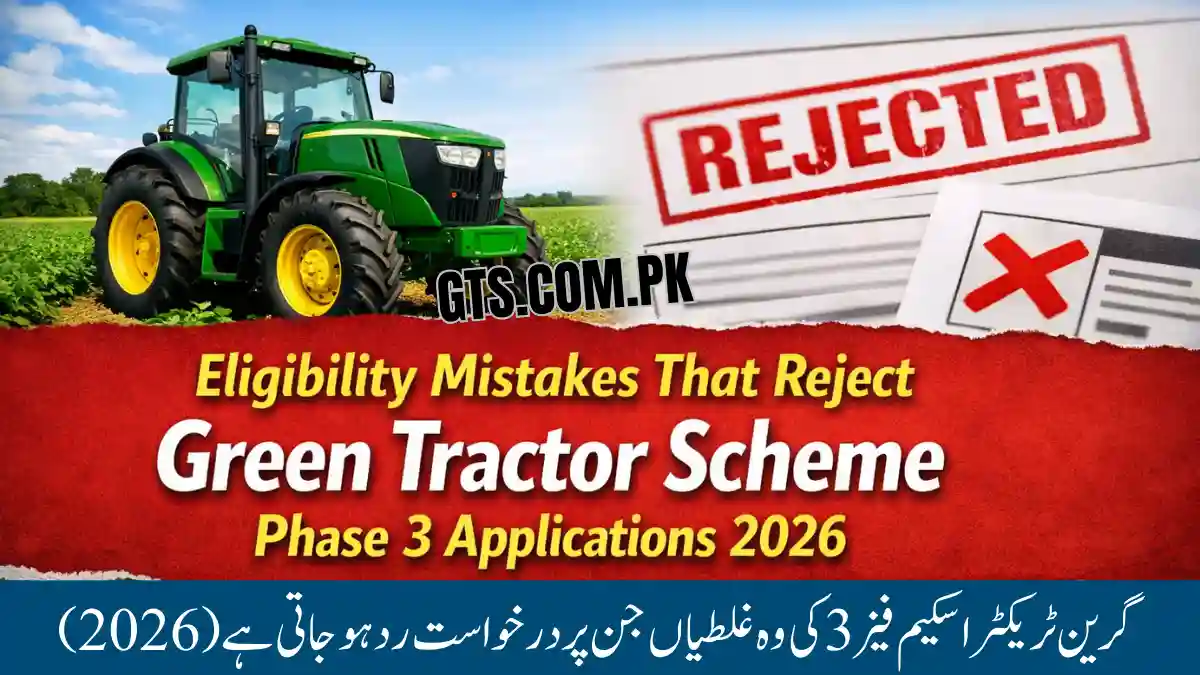
Eligibility Mistakes That Reject Green Tractor Scheme Phase 3 Applications 2026
Green Tractor Scheme Phase 3 Eligibility Mistakes are the biggest reason why many genuine farmers see their applications rejected despite meeting most requirements. Every year, thousands of applicants lose the subsidy simply because of small but critical errors that could have been avoided with proper understanding.
Understanding Why Applications Get Rejected in Phase 3
The CM Punjab Green Tractor Scheme Phase 3 was designed to support farmers with modern machinery and reduce financial pressure. However, the approval process is strict, and authorities closely examine every application.
Many rejections happen not because farmers are unqualified, but because they misunderstand documentation, overlook technical conditions, or submit incorrect details. These issues often fall under eligibility criteria errors, which can instantly disqualify an otherwise valid request.
To avoid rejection, it is essential to understand where most applicants go wrong and how to correct those mistakes before submission.

Green Tractor Scheme Phase 3 Eligibility Mistakes That Farmers Commonly Make
This section focuses on the most frequent Green Tractor Scheme Phase 3 Eligibility Mistakes that directly lead to rejection. Each mistake may seem minor, but even one error can result in subsidy disqualification.
Incorrect Personal and Farm Details
One of the most common problems is providing wrong information in personal or farm-related fields. This includes:
- Incorrect CNIC numbers
- Misspelled names
- Mismatch between NADRA and land records
- Wrong mobile number or address
Authorities cross-check data with government databases. If details do not match exactly, the system flags the application automatically.
Farmers should always double-check spellings and numbers before final submission. Even a single digit error can invalidate the entire application.
Land Ownership and land mismatch Issues
Land verification is a critical part of the scheme. Many applications fail because of land mismatch between declared land and official revenue records.
Common land-related issues include:
- Claiming land not registered under the applicant’s name
- Using outdated land records
- Errors in khasra or khata numbers
- Joint land ownership without proper consent documents
Table 1: Common Land Verification Errors and Their Impact
| Land Issue | Result |
|---|---|
| Unregistered land | Immediate rejection |
| Joint ownership without proof | Application on hold or rejected |
| Incorrect land area | Disqualification |
| Outdated land record | Verification failure |
Farmers should update land records before applying and ensure documents are clear, current, and legally valid.
Not Meeting farmer eligibility Conditions
Many applicants assume that owning land is enough. However, the scheme has strict farmer eligibility requirements that must be met fully.
These include:
- Minimum landholding size
- Active farming status
- No previous misuse of government subsidies
- Compliance with phase 3 rules
Applicants who do not meet all conditions, even if they meet most, are rejected without appeal.

Documentation Errors That Lead to Rejection
Paperwork errors are another major reason applications fail. Authorities rely heavily on documentation to verify claims.
Uploading Low-Quality or Incorrect Documents
Blurred images, incomplete scans, or wrong file uploads often result in rejection. This is a classic example of eligibility criteria errors that could be avoided easily.
Documents must be:
- Clear and readable
- Uploaded in the correct format
- Properly labeled
- Valid and up to date
Uploading a wrong document, even accidentally, counts as wrong information.
Missing Mandatory Attachments
Some farmers skip attachments thinking they are optional. In reality, missing documents almost always lead to subsidy disqualification.
Required documents often include:
- Land ownership proof
- CNIC copy
- Tax or agricultural registration certificates
- Bank account verification
Missing even one document can stop the application from moving forward.

Violating Technical and Scheme-Specific Conditions
Beyond documents and personal details, many applicants fail due to not understanding technical requirements.
Ignoring Approved Tractor Specifications
Phase 3 only allows tractors that meet specific environmental and efficiency standards. Applying for a non-approved model violates phase 3 rules.
Applicants must ensure:
- Tractor model is officially approved
- Engine capacity falls within allowed range
- Dealer is registered with the scheme
Failure to follow these rules leads directly to rejection.
Previous Subsidy Conflicts
Farmers who previously received similar subsidies may unknowingly violate farmer eligibility rules. The system tracks subsidy history, and duplicate benefits are not allowed.
This is a silent but serious cause of subsidy disqualification.

Financial and Banking Errors
Financial details play a crucial role in approval and payment processing.
Incorrect Bank Account Information
Providing wrong information related to bank accounts can delay or cancel approval.
Common banking mistakes include:
- Account not in applicant’s name
- Closed or inactive account
- Incorrect IBAN
Bank verification failures often result in rejection even after initial approval.
Outstanding Government Liabilities
Applicants with unpaid government dues or loan defaults may fail eligibility checks. This is strictly enforced under phase 3 rules.
How to Avoid These Mistakes Before Applying
Understanding Green Tractor Scheme Phase 3 Eligibility Mistakes is only useful if farmers take preventive action.
Pre-Submission Checklist for Farmers
Table 2: Smart Application Checklist
| Step | What to Check |
|---|---|
| Personal details | CNIC, name, address accuracy |
| Land records | Updated and matching official data |
| Documents | Clear, correct, complete |
| Tractor model | Approved under Phase 3 |
| Bank details | Active account in applicant’s name |
Following this checklist significantly reduces the risk of eligibility criteria errors.
Seek Verification Before Final Submission
Farmers should consult agricultural offices or official helplines to confirm compliance with farmer eligibility standards. A small verification step can prevent major losses later.
FAQs
1. Can a small spelling mistake really cause rejection?
Yes, even minor spelling errors are treated as wrong information and can lead to rejection during verification.
2. What happens if my land is jointly owned?
Joint ownership often leads to land mismatch unless proper legal consent and documentation are provided.
3. Can I reapply if my application is rejected?
Reapplication may be allowed in future phases, but repeated eligibility criteria errors reduce approval chances.
4. Does previous subsidy usage affect Phase 3 eligibility?
Yes, prior subsidies can impact farmer eligibility and may result in subsidy disqualification.
5. Are tractor dealers involved in verification?
Yes, tractor specifications and dealer registration are checked under phase 3 rules.
Final Thoughts
Avoiding Green Tractor Scheme Phase 3 Eligibility Mistakes requires attention to detail, accurate documentation, and a clear understanding of official requirements. Most rejections are preventable when farmers verify their information, comply with land and financial rules, and follow the scheme guidelines carefully.
By preparing properly and avoiding common errors, applicants can significantly improve their chances of approval and successfully benefit from the scheme.