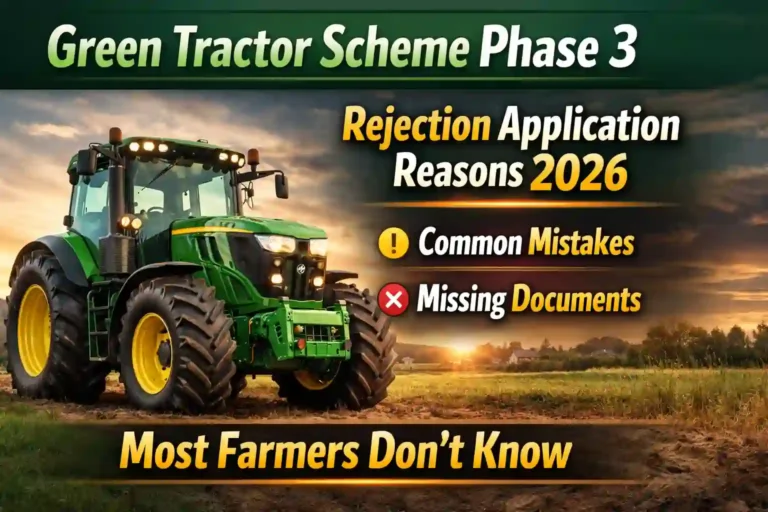

Green Tractor Scheme Phase 3 Eligibility For Joint Land Owners 2026
The Punjab Government has taken a major step toward inclusive agricultural development by formally outlining Green Tractor Scheme Phase 3 Eligibility For Joint Land Owners 2026. This long-awaited clarification brings renewed hope for thousands of farmers who cultivate land under joint ownership arrangements, a common practice across rural Punjab.
By recognizing shared landholding structures and aligning them with modern agricultural reforms, the government aims to ensure fairness, transparency, and equal access to subsidized farming machinery.
Introduction to Green Tractor Scheme Phase 3
The Green Tractor Scheme GTS is a cornerstone initiative under the broader Punjab Land Policy, designed to strengthen the agricultural sector through mechanization. Phase 3 builds upon earlier rounds by addressing gaps that previously limited participation for joint landowners.
This phase reflects the government’s intention to support real farmers by refining Scheme Conditions and ensuring that ownership verification is both practical and transparent.
Key Goals of Phase 3
- Improve access to modern tractors
- Support small and medium-scale farmers
- Resolve ownership challenges under Shared Land Eligibility
- Ensure fair implementation of Joint Ownership Rules

CM Punjab Green Tractor Scheme Phase 3 Eligibility For Joint Land Owners
The most significant development in this phase is the formal recognition of Green Tractor Scheme Phase 3 Eligibility For Joint Land Owners, particularly those holding land under collective ownership records.
Definition of Joint Land Ownership
Joint land ownership refers to agricultural land registered in the names of multiple individuals, often due to inheritance. Such ownership is officially recorded as Fard Mushtarka in Punjab’s land revenue system.
Updated Joint Ownership Rules
Under revised Joint Ownership Rules, applicants must fulfill the following criteria:
- Applicant’s name must be listed in official Fard Mushtarka
- Land must be agricultural and located within Punjab
- Applicant must be actively engaged in farming activities
- Only one tractor is allowed per shared landholding
These rules aim to prevent misuse while protecting genuine farmers.

Shared Land Eligibility Explained
Understanding Shared Land Eligibility is essential for joint landowners planning to apply under Phase 3.
Land Share and Minimum Requirement
Eligibility is assessed based on the total landholding rather than individual portions. However:
- Individual land share must be clearly documented
- Combined land area must meet minimum scheme requirements
- Ownership details must match digital land records
This approach ensures equal opportunity without discrimination against joint owners.
Consent and Dispute Prevention
To avoid future disputes, the scheme allows authorities to request consent from co-owners where necessary, reinforcing transparency under updated Scheme Conditions.

Importance of Fard Mushtarka in Phase 3
Fard Mushtarka serves as the backbone of eligibility verification in Phase 3.
Why Fard Mushtarka Is Mandatory
- Confirms legal joint ownership
- Clearly defines land shares
- Acts as verified Farmer Ownership Proof
Without a valid and updated Fard Mushtarka, applications will not be processed.
Digital Verification System
Through land record digitization under the Punjab Land Policy, authorities now verify ownership electronically, reducing delays and eliminating fraudulent claims.

Farmer Ownership Proof Requirements
Submission of authentic Farmer Ownership Proof is compulsory for all applicants.
Required Documentation
Applicants must provide:
- Valid CNIC
- Updated Fard Mushtarka
- Proof of agricultural activity (if requested)
- Self-declaration affidavit
These requirements ensure that the subsidy reaches working farmers rather than speculative landholders.
Punjab Land Policy and Agricultural Reform
The revised Punjab Land Policy plays a pivotal role in making Phase 3 inclusive and farmer-friendly.
Policy Enhancements in Phase 3
- Legal recognition of joint land ownership
- Clear enforcement of Joint Ownership Rules
- Digital land verification systems
- Reduced manual interference
This policy shift signals long-term commitment to sustainable agricultural growth.
Application Process for Joint Land Owners
The application process has been streamlined for ease and accountability.
Step-by-Step Application Method
- Access the official Agriculture Department portal
- Complete the online application form
- Upload all required Farmer Ownership Proof
- Submit application and track status digitally
Applicants are advised to ensure accuracy to meet all Scheme Conditions.
FAQs
1. Are joint landowners fully eligible under Phase 3?
Yes, farmers meeting Green Tractor Scheme Phase 3 Eligibility For Joint Land Owners criteria are fully eligible, provided ownership is verified through Fard Mushtarka.
2. Is individual land share acceptable for application?
Yes, as long as the land share is officially recorded and falls under Shared Land Eligibility guidelines.
3. Can outdated land records affect approval?
Yes, outdated or unverified Fard Mushtarka records may lead to rejection. Applicants must update records before applying.
4. How many tractors are allowed for joint landholdings?
Only one tractor is permitted per shared landholding under current Scheme Conditions.
Conclusion
The clarification of Green Tractor Scheme Phase 3 Eligibility For Joint Land Owners 2026 represents a transformative step in Punjab’s agricultural policy. By formally acknowledging joint ownership structures, reinforcing Farmer Ownership Proof, and integrating digital verification under the Punjab Land Policy, the government has created a more inclusive and transparent system.
For joint landowners, this phase removes uncertainty and opens doors to modern farming equipment that can significantly enhance productivity. Farmers are encouraged to prepare accurate documentation and apply within the official timeline to fully benefit from this progressive initiative.